Wednesday, December 10, 2008

After a Downward Revision, Buenaventura Back to a Buy

Research by IIR Group, published December 8, 2008, sets a new price target for Buenaventura (NYSE: BVN) at US$17.39 per ADR, maintaining a BUY after a downward revision from the September target of US$35.48. The analysis estimates Net Earnings for 2008 through 2010 at US$667, US$299 and US$409 million, and uses target ratios EV/EBITDA and Price/Sales at 12.0x and 6.0x respectively, when arriving at the US$17.39 price target. EV/EBITDA and Price/Sales target ratios were 20.0x and 12.0x in the September analysis, but were adjusted down to reflect the 'downturn in the commodity cycle and global economic growth.'

The current price per ADR at US$16.03 reflects an upside potential of 8.48% over the coming 6-12 months.

Inca Invest Commentary

Equity production for the nine-month period ending September 30, 2008, was 308.683 ounces of gold, up from 295.034 in 2007. Silver production reached 11.557.431 ounces, up from 10.541.795. In addition, the reported equity production from Yanacocha, where the company owns 43.65%, was reported at 915.859 ounces. Equity production of copper at Cerro Verde (18.68% share) was reported at 235.120 metric tonnes.

Average realized prices for gold, silver and copper were US$906/oz, US$16.49/oz and US$7.990/MT respectively. Net Income attributed to Buenaventura for 3Q’08 was US$100.6 million, representing 48.45% of revenues.

Project Development

Accumulated investments related to the Uchucchacua project’s deepening and integration of Carmen and Socorro mines was reported at US$10.3 million at the end of 3Q’08, and will be completed in 1Q’09.

In addition, expansion of the plant, from 2.500 to 3.000 STPD, has been completed, and operations began in September.

At Orcopampa, the construction of ramps 15 and 16, which includes 720 meters of drifting, was reported as 91% complete, with US$3.5 million in investment.

The construction of facilities to permit recovery of approximately 53.000 ounces of gold in 2008 and 2009 was completed in August. Accumulated investment was US$10.9 million.

Outlook

The company’s financial position on September 30 showed the following key ratios:

Share Price 16.03 YTD performance -45.82 %
Market Cap (mln USD) 5681.03 Debt Ratio 0.26
Book-to-Market ratio 0.31 Debt-to-Equity Ratio 0.36
EV/EBITDA 16.80 ROA 20.20%
Current Ratio 3.20 ROE 26.88%
Quick Ratio (Acid Test) 3.01


BVN reported US$392.6 million in cash and cash equivalents at the end of 3Q, up from US$112 million in 2007.

The ADR has found technical support at 15.0, and is testing resistance at the long-term trend channel. Money Flow indicators are inconclusive (RSI ~50). If the recent Dollar strength is to continue, expect this to reflect negatively on the gold price, and in turn BVN.

A bullish break-out above 16.5 would signal a test of resistance at the November 28 close at 18.0.

------------------------------------------------------------------------------------------------------------------
GoldTraderAsia.com - Where to Buy and Sell Gold Bullion Bars, Gold Ingots, Gold Coins Collection and Gold Jewellery in Singapore.

To buy Hallmarked 999.9 Pure Swiss Gold Bars, Gold Bullion, Gold Ingots & 916 Gold Coins in Singapore or convert your 916 Physical Gold to physical 999.9 Pure Swiss Gold Bars, Click on Buy Gold Bullion Bars to find out more. You may Sell Gold Bullion Bars to us too.
------------------------------------------------------------------------------------------------------------------

A junior gold stock for the brave

By Dominic Frisby

Recently, several of you have asked me to tip some junior gold miners that I like. I have been reluctant to mention anything in the current market. But, while wild daily volatility is now the menu du jour, I think we have reached a reasonably low-risk entry point for some junior gold stocks.

Gold mine in  Brazil

Time to buy - for the bold investor only

In fact, based on how they have performed in previous post-bubble contractions, there is a good chance gold stocks could be the star performer over the next few years.

I may be wrong, of course - but then, I may also be right...

A stock for the brave

A company I mentioned in my last cover story for MoneyWeek (Why gold will shine again) is Sacre Coeur Minerals (CA:SCM). It trades on the TSX Venture exchange in Canada so you'll need a broker that deals in Canadian stocks if you want to buy it. It also trades in Frankfurt under the ticker S5N, but, for reasons of liquidity, it may be easier to buy in Canada.

The company's share price closed on Monday night at 25c, which gives it a market cap of just over C$7m. With just under C$6m in the bank, the group is trading at just above its cash value. Its burn rate is about C$200,000-250,000 per month. So you're getting some very nice assets almost for free.

Sacre Coeur is developing various properties in mineral-rich Guyana in South America, of which the Million Mountain project is the most exciting. With her rich history of mining and miner-friendly culture, Guyana is fairly low on the risky countries list. Several majors, among them Newmont, have operated there successfully, and Cambior's now almost-exhausted Omai mine produced over four million ounces of gold.

Sacre Coeur's Million Mountain project shares many of the same geological traits as Omai. It has so far proven up almost half a million gold ounces of measured and indicated resource in the ground, having explored just 2% of the surface area covered by identified gold anomalies. Even if the other zones prove to be half as good, basic maths suggests this will turn out to be a similarly large, near-surface (i.e. easy-to-mine) elephant deposit.

The future of Sacre Coeur

Sacre Coeur now has to make a decision on the way forward. It can spend money developing the project with a view to being bought out – and management has a successful record in this area. But the company is already in a position where it can build a small mine cheaply and produce say 20,000-30,000 ounces a year at a cash cost in the US$300-400 range, and then use the cash to develop the rest of the assets. I'd like to see the group go for the latter option as I think it's the safest in the current environment, but CEO, Irwin Olian, has shown a remarkable ability to raise money even in horrible markets like this.

Money Morning readers will remember Olian as the boss of Pan African, which I tipped at last spring at around $2.30. It was bought out a few months later at $4.50 a share, with holders also getting a share in the spin-off company now called African Queen Minerals (which Olian also heads). Olian is a serial entrepreneur with a marvellously varied career. Formerly of Harvard and Princeton, he was for many years a lawyer in the movie business with Warner, before moving into corporate finance. He has founded several public companies, including two biotech companies in the late 90s, which were multi-baggers for their investors. He has an unblemished record of making money for his shareholders.

In the heady pre-crash days of the summer, I was a buyer of Sacre Couer above a dollar. Here at 25-30c (less than 10% of its high around C$3.50) is a chance to get it for a lot less.

This stock has potential, but it's high risk

So why is Sacre Coeur so cheap? Because Sacre Coeur is a small-cap stock. And when an institution is forced to liquidate its position in a small-cap, it decimates the company. It's that word again: deleveraging – and it has decimated the whole junior sector.

It's possible that funds have now stopped bailing out of this company, because from the last two or three weeks of action it appears sellers are no longer hitting the bid. But no guarantees. This has the potential to be a five-to-ten-bagger – even if it just retraces half of its decline - but it is still a high-risk, speculative junior and you should only allocate a corresponding amount of capital – 'money you can afford to lose', if you have such a thing.

It may be that funds haven't yet finished their selling and will take advantage if there's a sudden surge in buying to offload stock, which does nobody any favours, so my advice is to patiently accumulate. That's what I've been doing – as has Olian, as evidenced by the SEDI reports which show insider buying and selling. Given his track record, that's got to be a good sign.

------------------------------------------------------------------------------------------------------------------
GoldTraderAsia.com - Where to Buy and Sell Gold Bullion Bars, Gold Ingots, Gold Coins Collection and Gold Jewellery in Singapore.

To buy Hallmarked 999.9 Pure Swiss Gold Bars, Gold Bullion, Gold Ingots & 916 Gold Coins in Singapore or convert your 916 Physical Gold to physical 999.9 Pure Swiss Gold Bars, Click on Buy Gold Bullion Bars to find out more. You may Sell Gold Bullion Bars to us too.
------------------------------------------------------------------------------------------------------------------

Tuesday, December 9, 2008

One Good Idea: Buy gold bullion

Gold appreciates amid inflation, defies deflation and is the ultimate defensive play

One Good Idea: Buy gold bullion


Dianne Maley, Globe Investor Magazine online, December 09, 2008

The Source: Eric Sprott, founder, CEO and portfolio manager, Sprott Asset Management Inc.

The Idea: Buy gold bullion.

“I can only recommend one thing: precious metals,” Mr. Sprott said in an interview. Governments worldwide are printing money furiously in a vain attempt to bail out the banking system and keep the economy afloat, he said. With the purchasing power of currencies being eroded, the only real safe haven is gold, he argues. “The developed world is throwing $20-trillion (U.S.) at the banking system. There are holes in the dike. You had better be ready for the worst of all possibilities.”

The allure of gold bullion is that it tends to hold its purchasing power, adjusting for currency shifts, rising with inflation and holding its value even in deflation. In a deflationary environment, even if the nominal price of gold just holds steady, its purchasing power will rise as other prices fall. That’s important, because Mr. Sprott says the world is in “a deflationary death spiral.”

Given the steepness of the economic slump, companies will be hard pressed to earn a profit and stock prices will languish, Mr. Sprott predicted.

“You’ve got to try to survive this thing.” What about buying precious-metal stocks or gold-backed certificates instead of the metal itself? “With stocks, you need the price to go up,” he said. “If you buy bullion, if it just holds its value, you will be okay.” Gold bullion could hold steady, yet gold stocks could fall.
“I own lots of gold stocks, don’t get me wrong. But to be really defensive, gold is the only place to be.” As for certificates, “I tend not to be a big believer in anything that is just a piece of paper in your hand … Our banks sold citizens $35-billion of paper they said was good but it wasn’t,” he said, referring to asset-backed commercial paper.

The Payoff: The purchasing power of your hard-earned dollars will be undiminished, regardless of what the future holds.

The Big Risk: The price of bullion could drop or prices of other investments could rise, leaving you to reflect that you could have done better investing in something else.

Why listen to Eric Sprott? Until this past summer, Mr. Sprott has had a stellar track record. But plunging commodity prices, especially for oil, dragged down both his hedge funds and the mutual fund he manages, the Sprott Canadian Equity Fund.

Since then, the hedge funds he manages have recovered and are flat to slightly higher for the year. The mutual fund, which cannot sell short, is down 47 per cent in the year to Nov. 28.

In October, a fund Mr. Sprott manages for international investors, the Sprott Offshore Fund Ltd., won an award from HFM Week, an industry publication, for the best long-short hedge fund in the world.

------------------------------------------------------------------------------------------------------------------
GoldTraderAsia.com - Where to Buy and Sell Gold Bullion Bars, Gold Ingots, Gold Coins Collection and Gold Jewellery in Singapore.

To buy Hallmarked 999.9 Pure Swiss Gold Bars, Gold Bullion, Gold Ingots & 916 Gold Coins in Singapore or convert your 916 Physical Gold to physical 999.9 Pure Swiss Gold Bars, Click on Buy Gold Bullion Bars to find out more. You may Sell Gold Bullion Bars to us too.
------------------------------------------------------------------------------------------------------------------

Hedging Gold

By Brad Zigler

I suppose I shouldn't have been surprised by the number of visitors to the San Francisco Hard Assets Conference who wanted to talk about wrestling the risk of their gold stock investments. After all, 2008 has turned out brutal for gold miners. Witness the AMEX Gold Miners Index off by 46% for the year.

Some of the conferees have been puzzling over their hedging options. And there are plenty of them: options, futures and exchange-traded notes, to name a few. This array leaves many wondering which hedge is optimal.

If you're pondering that question yourself, you first have to ask yourself just what risk you want to hedge. In a so-called "perfect" hedge, price risk is completely checked, effectively locking in the present value of an asset until the hedge is lifted.

Is that what you really want, though?

A less-than-perfect hedge neutralizes only a portion of the risk subsumed within an investment. Gold stocks, for example, provide exposure to both the gold and equity markets. Hedging a gold stock with an instrument that derives its value solely from gold may dampen the volatility impact of the metal market upon your portfolio, but leaves you with equity risk. This may be perfectly acceptable if you feel stocks in general - and your issues in particular - are likely to appreciate. Hedge out the gold exposure and you're more likely to see the value that the company's management adds. If any.

We touched on this subject in recent Desktop columns (see "Gold Hedging: Up Close And Personal" and "More On Hedging Gold Stocks").

More than one Desktop reader asked why the articles proposed a hedge strategy employing inverse gold exchange-traded notes - namely, the PowerShares DB Gold Double Short ETN (NYSE Arca: DZZ) - instead of stock-based derivatives such as options on the Market Vectors Gold Miners ETF (NYSE Arca: GDX).

Well, we've mentioned one of the advantages of a gold-based hedge already, but the question deserves a more detailed answer. Let's suppose, for illustrative purposes, you hold 1,000 shares of a gold mining issue now trading at $50 and are concerned about future downside volatility. [Note: The prices shown in the illustrations below are derived from actual market values.]

AMEX Gold Miners Index And ETF

The AMEX Gold Miners Index is a modified market-capitalization-weighted benchmark comprised of 33 publicly traded gold and silver mining companies.

While price movements in the index are generally correlated with the fluctuations of its components and other mining issues, the relationship isn't perfect. Close, but not perfect. The Gold Miners Index represents the market risk, or beta, specific to gold equities. Any hedge that employs an index-based derivative will need to be beta-adjusted to compensate for any differences in the securities' volatilities.

You have to consider the proper index-based derivative to be used in the hedge. The GDX exchange-traded fund could be shorted, but that would require the use of margin, something that some investors might abhor.

If you're not put off by margin, you'll first need to size your hedge. And for that, you'll need a beta coefficient for your stock. A quick-and-dirty beta can be approximated by taking the quotient of the securities' volatilities or standard deviations (you can get a stock's standard deviation through Web sites such as Morningstar and SmartMoney, or you can derive a beta more formally through a spreadsheet program such as Excel).

Gold Stock Volatility ÷ ETF Volatility = 94.8% ÷ 81.8% = 1.16

The ratio tells you how to calculate the dollar size of your hedge. If your stock is trading at $50, your $50,000 position would require $58,000 worth of GDX shares sold short. If GDX is $23 a copy, that means you‘ll need to short 2,522 shares.

Once hedged, you'll still carry residual risk. The volatility correlation could shift over the life of the trade, leaving you over- or underhedged. So you'll need to monitor the position for possible adds or subtractions. Hedging is not a "get it and forget it" proposition.

You'll also need fresh capital to place and maintain the hedge. There's the initial cash requirement of $29,000 (50% of $58,000) and possibly more if you hold your hedge through significant rises in GDX's price.

GDX Options

You can avoid margin altogether by using certain GDX options instead of a short sale. Purchasing puts on GDX, for example, gives you open-ended hedge protection against declines in gold equities like a GDX short sale but with a clearly defined and limited risk. There's no margin required, but you'll have to pay a cash premium to buy the insurance protection. And, like an insurance contract, the coverage is time-limited.

Let's say you can purchase a one-month option that permits you to sell 100 GDX shares, at $22 a copy, for a premium of $245. Keep in mind that the put conveys a right, not an obligation. You're not required to sell GDX shares. At any time before expiration, you can instead sell your put to realize its current value, or you can allow the option to expire if it's not worth selling.

Just how does the put protect you? Let's imagine that, just before expiration, GDX shares have fallen to $10. Your put guarantees you the right to sell GDX shares at a price that's now $12 better than the current market. That's what your option should be worth: $12 a share, or $1,200. If you sell it now, you'd realize a $955 gain that can be used to offset any concomitant losses on your gold stock.

To figure out how many puts are necessary to fully hedge your stock position, you'll need to extend the ratio math used previously.

Option prices only move in lockstep with their underlying stocks when they're "in the money" like the put illustrated above. The expected change in an option premium is expressed in the delta coefficient. If the delta of the $22 put, when GDX is $23, is .40, the option premium is expected to appreciate by 40 cents for every $1 GDX loses.

The arithmetic used to construct the full hedge is:

[Stock Value ÷ (Delta x 100 Shares)] x Beta = [$50,000 ÷ (.40 x 100)] x 1.16 = 1,450 puts

Here's where the efficacy of the GDX options hedge really breaks down. GDX's high price volatility has inflated the cost of hedge protection to impractical levels. The hedge would cost $245 x 1,450, or $355,250; much more than the potential loss that would be incurred if you remained unprotected. Clearly, the cost of hedging gold equity market risk, like the cost of insurance after a catastrophe, has been puffed up to protect the insurer.

Of course, you can elect to hedge only a portion of your stock position, but the high premium necessitates a large "deductible" on your market risk.

Wrapping Up

You'll note that some gold mining issues have options themselves. Using these as hedges in the current market presents another set of problems.

Given that the volatilities for individual issues are higher than that of GDX, the stock contracts are even more expensive than index options. Using stock options, too, would hedge away management alpha. Individual options, as well, are inefficient if you hold multiple mining issues in portfolio.

Now, consider the contrasting benefits attached to using the DZZ double inverse gold notes in your hedge: 1) no overpriced insurance cover, 2) you get to keep your stock's equity and management risk; you're only hedging out gold's volatility, 3) a single purchase can hedge any number of mining issues in portfolio, and 4) your insurance doesn't expire.

Seems to me that DZZ has the edge.

------------------------------------------------------------------------------------------------------------------
GoldTraderAsia.com - Where to Buy and Sell Gold Bullion Bars, Gold Ingots, Gold Coins Collection and Gold Jewellery in Singapore.

To buy Hallmarked 999.9 Pure Swiss Gold Bars, Gold Bullion, Gold Ingots & 916 Gold Coins in Singapore or convert your 916 Physical Gold to physical 999.9 Pure Swiss Gold Bars, Click on Buy Gold Bullion Bars to find out more. You may Sell Gold Bullion Bars to us too.
------------------------------------------------------------------------------------------------------------------

Retail Gold Buyers Still Face Shortages, High Mark-Ups as Global Credit & Lending Collapse; Central Banks Prepare "Money Flood"

London Gold Market Report
By: Adrian Ash, BullionVault

THE PRICE OF GOLD in the world's professional wholesale market held inside a tight $10 range early Tuesday in London, drifting up from $768 an ounce as global equities rose for the third session running.

"As the wind-down to the holiday season nears and investors draw a line under 2008, gold is trending towards a range bound closure," says today's Gold market note from Mitsui, the precious metals dealer in London.

"Following the substantial moves this year, this conclusion is welcomed."

Crude oil ticked back below $44 per barrel and government bond yields remained in sight of all-time record lows as the US Dollar bounced on the forex markets.

The Gold Price in Sterling traded above £520 per ounce on news of a sharp rise in the UK trade deficit.

French investors saw gold touch €600 after France reported a record trade gap of €7.1 billion for Oct. – up by almost one-fifth from Sept. – plus a sharply higher government deficit.

New data showed Japanese output shrinking 0.5% between June and Oct., putting the world's No.2 economy in line for its longest post-war contraction to date.

Taro Aso, the prime minister, is said to be planning a ¥20 trillion ($216bn) stimulus, worth more than 3.5% of Japan's annual economy. Sony Corp. will meantime slash more than 16,000 jobs, Bloomberg reports, in a bid to reduce costs by $1.1 billion.

Today in Beijing a central banker warned that Chinese exports actually fell last month from a year earlier, dragging industrial growth down to 5% from 8.2% in Oct.

"With a dramatic fall in oil prices, Gold also lost a lot of ground," reports Wolfgang Wrzesniok-Rossbach in his latest Precious Metals Weekly for Heraeus, the German refinery group.

"Even then, currently trading at $770 an ounce, the yellow metal is showing far greater resilience than for example any of the [industrial] platinum group metals.

"We do not expect much to change in the coming days."

Today the Bank for International Settlement (BIS) – founded at the depth of the 1930s' global depression – said that global bank lending ground to a halt during the first six months of this year.

Swollen by more than one-third during the preceding year-and-a-half, outstanding cross-border loans in fact shrank by $1.1 trillion in June – down some 3.2% from March.

Trading in all derivative contracts continued to grow, however, reaching $863 trillion by the end of June and up by one-fifth from New Year's Day. But bond-market insurance in the form of credit default swaps (CDS) "registered the first ever decline" the BIS says, shrinking by 1% after clocking up an average six-month growth rate since 2005 of 45%.

"Who will win the race to zero?" now the world faces deflation in asset and credit markets, asks Steven Barrow from Standard Bank here in London today.

"The smart money seems to be on the Fed, but the Swiss National Bank could yet pip the Fed at the post. It meets Thursday and, after taking a scythe to interest rates in the last month, or so, a zero rate seems pretty close."

Today the Swiss Franc slipped 1% vs. the US Dollar, helping the price of Gold for Swiss investors tick higher to CHF 935 an ounce – virtually unchanged from the start of 2008.

Gold pays no interest already, of course, a prime motivation for the central-bank gold sales advised by investment-bank consultants in the 1990s which led to the current limits and caps of the Central Bank Gold Agreement.

"If rates do move to the vicinity of zero later this week," says Barrow, "it may also be the Swiss National Bank that's the first to fully adopt a quantitative easing strategy...flooding the market with cash."

Meantime in the Gold Investment market, "There is a shortage of Krugerrands," reports MiningMX.com in Johannesburg, quoting Alan Demby – executive chairman of the South African Gold Coin Exchange.

"I think we deal with the retail investor, or collector if you will," said Demby on last night's SAfm radio show. "Clients buy between, say, one and 2,000 coins.

"Our clients tend to be on average long-term hoarders, if you will, for want of a better word, and at some stage they might wish to sell or hand it over to their children or grandchildren.

"There are over 55 million Krugerrands" in circulation, Demby notes, yet despite this huge volume of outstanding supply, the price asked of would-be buyers has risen way ahead of their actual gold content in 2008, more than doubling since July alone, according to the Coin Dealer Newsletter.

Charted by Gene Arensberg at Resource Investor, the premium-to-spot prices charged by US coin dealers now stands at $45 per ounce on average – a huge 6% mark-up to the actual value of each coin's gold content, and a premium that's risen more than three times over since the start of 2006.

For investors wanting to buy small Gold Bars, "Differing situations exist in delivery periods," says Wrzesniok-Rossbach at Heraeus, the German refinery. "Minted investment bars with weights from 1 gram to 100 grams still have significant delays, whereas casted bars of 250 grams up to a kilogram can be delivered more or less promptly.

"An easing in the small bars situation is not to be expected before Christmas."

Over in the wholesale gold market, however – where professional dealers trade up to $60 billion worth of 400-ounce, wholesale gold bars each day through the London market – supply has remained deep and liquid all year.

These bars are the Spot Gold market – the benchmark price of solid gold over which coin collectors and small-bar buyers having to "pay retail" are then charged those premiums.

Adrian Ash
BullionVault

Gold price chart, no delay | Gold investment – simple, safe & efficient

Formerly City correspondent for The Daily Reckoning in London and head of editorial at the UK's leading financial advisory for private investors, Adrian Ash is the editor of Gold News and head of research at BullionVault – where you can Buy Gold Today vaulted in Zurich on $3 spreads and 0.8% dealing fees.

(c) BullionVault 2008

------------------------------------------------------------------------------------------------------------------
GoldTraderAsia.com - Where to Buy and Sell Gold Bullion Bars, Gold Ingots, Gold Coins Collection and Gold Jewellery in Singapore.

To buy Hallmarked 999.9 Pure Swiss Gold Bars, Gold Bullion, Gold Ingots & 916 Gold Coins in Singapore or convert your 916 Physical Gold to physical 999.9 Pure Swiss Gold Bars, Click on Buy Gold Bullion Bars to find out more. You may Sell Gold Bullion Bars to us too.
------------------------------------------------------------------------------------------------------------------

Is It Time to Buy? What History Shows

The market can be frustrating. Just a few weeks ago it looked like the markets were about to reach lows we haven’t seen since the early 90’s.

The commodity bubble was bursting, hedge funds were imploding, and it seemed like the selling would never stop. To add fuel to the fire, unemployment was getting worse, consumers started saving again (seemingly all at the same time, which isn’t very helpful), and practically every week another bank failed.

It was disastrous. The government was handing out cash to banks and guaranteeing private companies’ commercial paper while putting trillions of dollars it doesn’t have at risk. It seemed like a depression wasn’t out of the question, but all of that’s starting to change.

Consider what’s happened over the past few weeks. Citigroup (NYSE:C) practically failed. It has become painfully obvious that despite a multi-billion dollar bailout, one of Detroit’s Big Three is going to go away, either through merger or through bankruptcy. Retailers reported the sharpest holiday shopping season declines in decades, and the unemployment rate is climbing faster and faster.

There’s almost no good news, but the market is still up. Sometimes it just doesn’t make any sense. However, it could be telling us something - the recent rally could be a giant signal the worst is behind us.

All the Signs of a Market Bottom

A few weeks ago, we looked at the five telltale signs of a market bottom. At that time, we saw four of the five signs, but were still waiting for one more in order to start seriously considering a market bottom.

The first four signs a bottom was nearing were confirmed. Investors were baling out of mutual funds at record pace, the VIX set new highs, more than 90% of closed-end funds were trading at a discount (much higher than normal), and a perma-bear like Jeremy Grantham was turning bullish.

We were just waiting on one more: the market to react positively to horrible news.

Over the past few weeks, we’ve seen just that. When Citigroup declared it was about to go under, the market went up. When the market learned 533,000 jobs were lost in November (much more than even the worst-case expectations), stocks went up. The market is skipping right past otherwise horrible news.

That’s not all. Although we have all five signs of a market bottom we’ve been waiting for, there are quite a few more reasons to start turning more positive on the markets.

Discounting the Future

The market is supposed to be a forward-looking discounting machine. It’s supposed to price in what’s expected to happen over the next few months and years.

Is the market perfect at this? No. If it were, there would be no real opportunity to do well in it.

The market is, however, very good at incorporating what the masses expect for the future. It does it all in one quantifiable place, and right now, those expectations are for a turnaround to come sooner, rather than later.

The recent rallies have shown the market is anticipating the economy to stabilize and possibly begin its recovery in a matter of months. Just take a look at what is happening.

Goldman Sachs’ research department (yes, I know, who would listen to them after all that’s happened between a $200 oil forecast and the credit crisis and all?) released some historical precedents on how the market anticipates a recovery. In their defense, predicting the near-term future is darn near impossible, but these are historical facts. According to the bank:

The S&P 500 tends to bottom:

One quarter before the GDP bottoms
3 months before the ISM manufacturing survey bottoms
7 months before the peak unemployment rate
4 months before the largest decline in non-farm payrolls and
4 months before the bottom in consumer confidence surveys

If the market truly did hit rock bottom in November, we can expect a genuine economic recovery somewhere between March and June of 2009.

Believable? I wouldn’t bet on it, but it’s certainly possible. So, here’s what to do.

Where Do We Go From Here

If history is any evidence, it’s time to buy stocks.

The five signs of a market bottom are in. All the investment legends have turned bullish: Buffett, Grantham, Heebner, etc. We also got the market starting to anticipate this recession ending in less than a year. (Granted, I’m still concerned too many people are watching for a bottom to actually happen).

Of course, I’m still hesitant on calling “the bottom.” Trying to time the bottom is a fool’s game. Even though, it’s certainly tempting to do so after watching the market climb for two days. Frankly, there are still a lot of unanswered questions posing a lot of risk.

When will the housing market hit bottom? How will overleveraged commercial property companies fare? How bad will this holiday shopping season really be?

However, there still are some even bigger questions we have to deal with. Like, how high will the unemployment rate go? I’m still expecting it to top out over the summer in the 8% to 9% range. From that point, an economic recovery will really take quite a bit of time to get going again.

The government isn’t helping matters either. For instance, when will the government stop borrowing hundreds of billions of dollars from the banks (T-bills currently yield 0.01%) and trying to figure out why the banks don’t have the extra cash to lend to profit-seeking businesses? How much capital is going to override market forces and determine the best place for investment? Will it be roads and bridges, alternative energy, or electric cars?

There’s just too much uncertainty out there right now to go “all in.” I still recommend sticking to the plan of buying stocks consistently over the next year. You have to keep enough cash on hand to live and just in case, an even better buying opportunity comes along to pick up stocks even cheaper. For now though, I’m still buying stocks and sticking to the plan.

The Three Places I’m Buying

Here are three places that I really think some great returns can be had in the next few months, and years:

1. Biotech

Over the next 10 years, stem cells will change the world we live in. Every week a new development is made and the research is ongoing. It’s reaching that point where stem cells are at the verge of going mainstream.

There are already some amazing stories cropping up about the effectiveness of stem cells and there are only going to be more and more over the next few years. Stem cells are making miracles happen and the last 20 years of research are starting to pay off.

Here at the Prosperity Dispatch, we fully expect biotech (stem cells in particular), after years of underinvestment, to have all the legs of a major bull run and the real possibility of forming the next bubble. It’s only a matter of time until the market realizes it.

2. China

Over the past few months, shares of Chinese companies have held up remarkably well. This time around, the China boom is going to look a lot different. The last decade has been led by China building infrastructure and working aggressively to become the manufacturer to the world.

The next boom in China will come from the maturing of the economy as it slowly starts to move away from the highly cyclical manufacturing industries and into less-cyclical service industries.

If China is where the U.S. was at 100 years ago, then there are many great years ahead. If the U.S. were where the U.K. was at 100 years ago, I’d definitely continue to look outside the U.S. for long-term opportunities.

3. Gold

Although we’ve taken the past few days to look at gold and when (and if) a bull market will resume, and a few different ways to get in on what could be a big bull run for gold, there’s one thing that really has caught my attention recently.

The XAU/Gold ratio is a measure of index of leading gold mining companies (XAU – Philly Gold and Silver Sector Index) relative to gold price. Over the past 25 years, the XAU/Gold ratio has been 0.25. That means the XAU index would be about ¼ the price of an ounce of gold.

On Monday, the XAU closed at 94 while gold closed at $760 an ounce. This makes the XAU/Gold 0.124. That’s less than half the ratio’s long-run average and just off the 25-year lows.

It’s either a very bullish sign for gold stocks or a very bearish signal for gold. Something has to give and I’m currently working out a short gold/long gold stocks trade to capitalize on it.

All signs point to a bottom, at least in the near term; however, in a market like this, it all could change in a matter of minutes. A single warning of more trouble ahead for China, another surge in unemployment, or more disastrous retail spending in the U.S., could easily put the brakes on any rally.

There are several concerns still facing the market and two strong up days like we’ve just had can easily create a false sense of confidence, but if you develop a plan, buy top-quality stocks in sectors which have exceptionally bright futures, and are willing to go in for a couple of years, you should be just fine.

------------------------------------------------------------------------------------------------------------------
GoldTraderAsia.com - Where to Buy and Sell Gold Bullion Bars, Gold Ingots, Gold Coins Collection and Gold Jewellery in Singapore.

To buy Hallmarked 999.9 Pure Swiss Gold Bars, Gold Bullion, Gold Ingots & 916 Gold Coins in Singapore or convert your 916 Physical Gold to physical 999.9 Pure Swiss Gold Bars, Click on Buy Gold Bullion Bars to find out more. You may Sell Gold Bullion Bars to us too.
------------------------------------------------------------------------------------------------------------------

Gold - Not the Safe Haven People Think it Is

Back in the old days, every good financial planner worth their salt would have recommended that a truly diversified investment portfolio contain at least 10%-15% of gold or gold stocks. This would have included a portion in real estate (not REITs), stocks and bonds.

Generally speaking, there are different reasons why a person would hold each type of asset. Stocks would be held for "long-term" capital appreciation. Bonds would be held for income and real estate would be the inflation hedge. Gold on the other hand would be held if the government couldn't pay its debts. You would never really want to be in the position of having to cash in on your gold position for obvious reasons. Instead, gold would be something that you pass on to your heirs as a just-in-case insurance policy.

I consider myself a precious metal investor of the most basic type. I do have 15% of my portfolio in gold and silver but I don't invest in gold and silver stocks. I consider precious metal stocks perpetual call options on the price of gold or silver. Therefore, I only speculate in the top gold and silver stocks, Barrick (ABX), Newmont (NEM), Agnico Eagle (AEM), Hecla Mining (HL), Silver Standard (SSRI) and Coeur D'Alene (CDE), when I see that the opportunity exists or that an "unimpeded" precious metal bull market is in place. Otherwise I stay out of precious metal equities.

Why do I stay out of gold equities except for the occasional speculative urges? As indicated in my previous articles on silver, dated November 25th, and gold, dated November 17th, there are market factors to consider before committing money to such a volatile portion of my investment portfolio that is dependent on both the price of gold going up and the general stock market not going down.

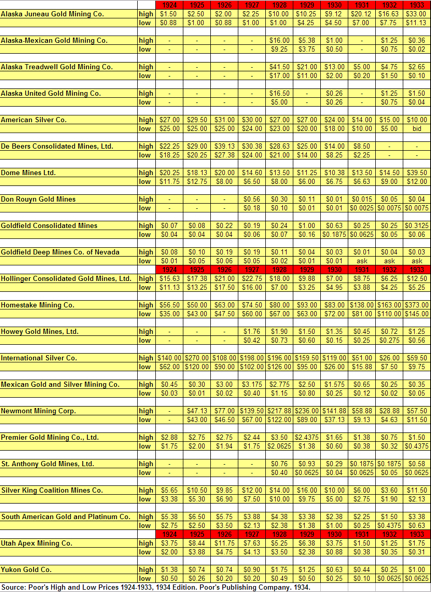
What confuses me about "gold bugs," as opposed to gold investors, is that as well informed as they are, gold bugs will not acquiesce to the idea that, generally, gold and silver stocks don't, can't and won't go up during a general stock market decline of 10% or more. Some gold bugs are willing to reference periods like 1929-1932 as a rational for why gold is a necessary hedge during a stock market collapse. To respond to such spurious claims from the gold bugs, I have included the price history of gold and silver stocks from 1924 to 1933. This data is from Poor's, the company that pre-dated the merger of Standard and Poor's.

click to enlarge

The price data of the 21 precious metal stocks is resounding since it puts to rest the idea that, a decline in the general stock market would result in an increase in the price of gold and gold stocks. Even with the price of gold being fixed at a $20.67 per ounce, investors were not overwhelmed by the idea of jumping into gold stocks as the highest quality blue-chip stocks crashed 89% from 1929 to 1932.

Notice that some gold stocks ran up in price and peaked before 1929. For the remaining stocks that did peak in 1929, take a look at the high and then the low in 1930. All of these stocks fell by at least 50% during this two year period. Some stocks would stabilize, while the majority would collapse until 1931 or 1932. Once hitting their bottom in 1931 or 1932, the stocks would then recover, along with the rest of the stock market. The only gold stock from this era that still trades on the New York Stock Exchange is Newmont Mining. Newmont went from the hefty price of $236 in 1929 to $4.63 in 1932. After 1932, all stocks started moving much higher regardless of the industry group the company was in.

The lone glaring exception to this survey is Homestake Mining. I would have loved to have bought Homestake in 1924 at $35 and never have to watch it fall back to where I got in. However, Homestake is a special situation that is completely unrelated to the general conditions of the market. Homestake Mining has become the rallying cry for gold bugs despite the fact that there are numerous special situations that can be pointed out in other industries during the same timeframe. Homestake Mining will be the subject of future postings on this blog for an understanding of the reason(s) why it went up in price in the face of a crashing stock market.

The only reason that gold was a place where money flooded in periods of panic (1807, 1819, 1826, 1837, 1842, 1861, 1865, 1876, 1884, 1893, 1904, 1907, 1932) was because of government price fixing. If I lived through a panic during any of the prior periods and found that everything was falling in value but the official price of gold was being propped by the government then, of course, I would seek safety in gold. However, without a gold standard, the price of gold has proven to be at the whims of the market as a commodity. Unfortunately, gold bugs have mistaken gold as a safe haven during a panic for the wrong reason. This explains why James Dines, the world’s most renown gold bug, openly wondered in his October 31st newsletter, “…why aren’t the prices of gold and silver commodities higher…”

Again, when the general stock market declines 10% or more then gold and silver will likely fall as well and may actually lead the decline on a percentage basis. The purpose of these articles on gold and silver is ensure that the money invested is done with an understanding of the forces in play. Gold bugs, understanding the dire nature of the government's fiscal and monetary position, might not be taking an investment position in gold but protection against the government recklessness. For everyone else, gold and silver are true commodities and should be treated as such.

The long term trend in gold and silver stocks as demonstrated by the Philadelphia Gold Stock Index [XAU], which was initiated in November 2000, will eventually head permanently higher. The continuation of that trend will be among the key indicators that the bear market in stocks is at or near an end.

------------------------------------------------------------------------------------------------------------------
GoldTraderAsia.com - Where to Buy and Sell Gold Bullion Bars, Gold Ingots, Gold Coins Collection and Gold Jewellery in Singapore.

To buy Hallmarked 999.9 Pure Swiss Gold Bars, Gold Bullion, Gold Ingots & 916 Gold Coins in Singapore or convert your 916 Physical Gold to physical 999.9 Pure Swiss Gold Bars, Click on Buy Gold Bullion Bars to find out more. You may Sell Gold Bullion Bars to us too.
------------------------------------------------------------------------------------------------------------------